

FACULTY

Research and Industry-Academia Collaboration
研究・産学連携

BEN ABDALLAH Abderazek
Professor, Regent (Dean of the Undergraduate school)
- Affiliation
- Department of Computer Science and Engineering/Division of Computer Engineering
- Title
- Professor, Regent (Dean of the Undergraduate school)
- benab@u-aizu.ac.jp
Education
- Courses - Undergraduate
- - Computer Architecture, Undergraduate level, UoA, 2018–present
- Introduction to Computer Systems, Undergraduate level, UoA, 2018–present
- Parallel Computer Systems, Undergraduate level, UoA, 2018–present
- Computer System Engineering, UoA, 2008–2018
- Embedded Systems, UoA, 2008–2016
- Logic Circuit Design Exercises, UoA, 2008–2016
- Courses - Graduate
- - Neuromorphic Computing, UoA, 2023 – present
- Embedded Real-Time Systems, UoA, 2008 – 2022
- Multicore Computing, UoA, 2010 – 2015
- Advanced Computer Organization, UoA, 2008 – 2023
Research
- Specialization
-
Computer system
- Educational Background, Biography
-
- 2002.4–2007.3 Research Associate, Univ. of Electro-Communications (UEC), Tokyo
- 2007.4–2007.9 Assistant Professor, UEC, Tokyo
- 2007.10–2011.3 Assistant Professor, The University of Aizu (UoA)
- 2011.4–2012.3 Associate Professor, UoA
- 2012.4–2014.3 Senior Associate Professor, UoA
- 2014.4–Present Professor, UoA
- 2014.4–2022.3 Head, Computer Engineering Division, UoA
- 2014.4–Present Member, Education and Research Council, UoA
- 2022.4–Present Director, Department of Computer Science and Engineering, UoA
- 2022.4–Present Dean, School of Computer Science and Engineering, UoA
- 2022.4–Present Regent, University of Aizu
- Current Research Theme
- Detailed research themes are presented on this page, and the resulting work has led to multiple patented technologies.
- Key Topic
- The research centers on advanced computing systems, spanning neuromorphic architectures, intelligent autonomous systems, and energy‑efficient multicore and manycore processors. His work emphasizes next‑generation platforms that tightly integrate perception, learning, and action, enabling intelligent behavior in real‑world environments.
- Affiliated Academic Society
- - Full Member, Sigma Xi – The Scientific Research Honor Society (Class of 2025)
- Senior Member, IEEE; Senior Member, ACM
- Member, IEEE Computer Society
- Member, IEEE Systems Council
- Member, IEEE Circuits and Systems Society (CASS)
- Member, IEEE CASS — Circuits and Systems Education and Outreach (CASEO) Technical Committee
- Member, IEEE CASS — VLSI Systems and Applications (VSA) Technical Committee
Others
- Messages for Students
- The University of Aizu is a place where curiosity and computing come together to create new possibilities. I encourage you to explore boldly, think independently, and collaborate as you deepen your skills in computer science and engineering. Your creativity and dedication strengthen our community. Make the most of every opportunity and continue challenging yourselves during your time here.
Main research
- AIzuHand: Real-time Neuromorphic Prosthetic Hand Platform
-

Prosthetic limbs can significantly improve the quality of life of people with amputations or neurological disabilities. With the rapid evolution of sensors and mechatronic technology, these devices are becoming widespread therapeutic solutions. However, unlike living agents that combine different sensory inputs to perform a complex task accurately, most prosthetic limbs use uni-sensory input, which affects their accuracy and usability. Moreover, the methods used to control current prosthetic limbs (i.e., arms and legs) generally rely on sequential control and power-hungry strategies with limited natural motion and long and complicated training procedures. This project develops an advanced real-time neuromorphic prosthesis hand, AIzuHand, with sensory integration and feedback sensing. In addition, we investigate a user-friendly software tool for calibration, real-time feedback, and functional tasks.
...read more
- Brain‑Inspired & Neuromorphic Computing
-
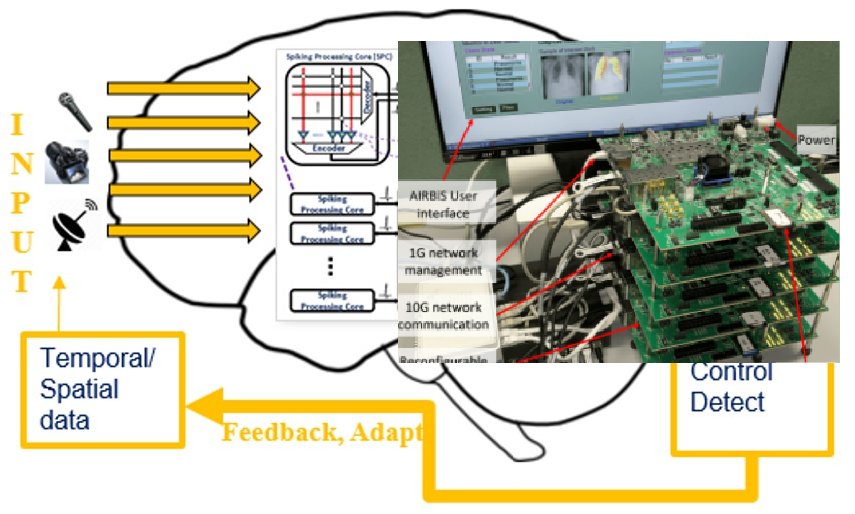
We are exploring the development of an adaptive ultra-low power neuromorphic chip (NASH) and systems, enhanced by our previously developed fault-tolerant three-dimensional on-chip interconnect technology. The NASH system boasts several features, including an efficient adaptive configuration method that enables the reconfiguration of various SNN parameters such as spike weights, routing, hidden layers, and topology. Additionally, the system incorporates a blend of different deep neural network topologies, an efficient fault-tolerant multicast spike routing algorithm, and an effective on-chip learning mechanism. To demonstrate the performance of the NASH system, we will develop an FPGA implementation and establish a VLSI implementation. The ultimate goal of NASH is to bring brain-inspired processing technology to small-scale embedded sensors and sensor-based devices, such as BCI (EEG/EMG), audio, presence detection, and activity recognition.
...read more
- Energy-Efficient Architectures: From Bio-Inspired AI SoCs to Green Computing
-

Our research in power and energy-efficient computing systems is essential to meeting the growing demand for more powerful and sustainable technology. As society increasingly relies on computing devices, managing their energy consumption becomes crucial. By developing efficient computing systems, we can significantly reduce energy costs, minimize environmental impact, and extend the battery life of portable devices. In large-scale data centers, enhancing energy efficiency leads to substantial cost savings and a reduced carbon footprint. Our work in this field fosters innovation in hardware and software design, paving the way for smarter, greener technologies that benefit both users and the planet.
...read more
- N-HuRo: Neuromorphic Humanoid Robotics
-
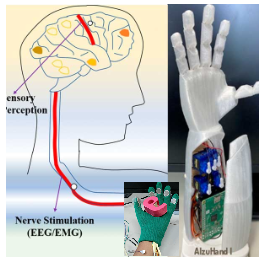
We advance next‑generation adaptive autonomous systems through neuromorphic AI, anthropomorphic prosthetics, and intelligent robotic platforms. Our work integrates neuroscience, AI, neuromorphic computing, and robotics to develop lifelike systems that operate autonomously while adapting to human intent and dynamic environments. Using neuromorphic architectures and spiking neural networks, we design control frameworks enabling natural interaction between artificial limbs, androids, and biological users.
We also develop non‑invasive neural interfaces for continuous intent decoding, and advanced sensory‑processing models that give androids human‑like perception and real‑time responsiveness. Extending these capabilities to distributed anthropomorphic robots, we study multi‑agent coordination, shared perception, and scalable autonomy. This research forms the foundation for future assistive technologies, human augmentation, and adaptive humanoid systems.
read more
- Sustainable Computing: World’s First AI‑Enabled Off‑Grid Energy‑Storage Solar Carport with Intelligent Energy Management
-
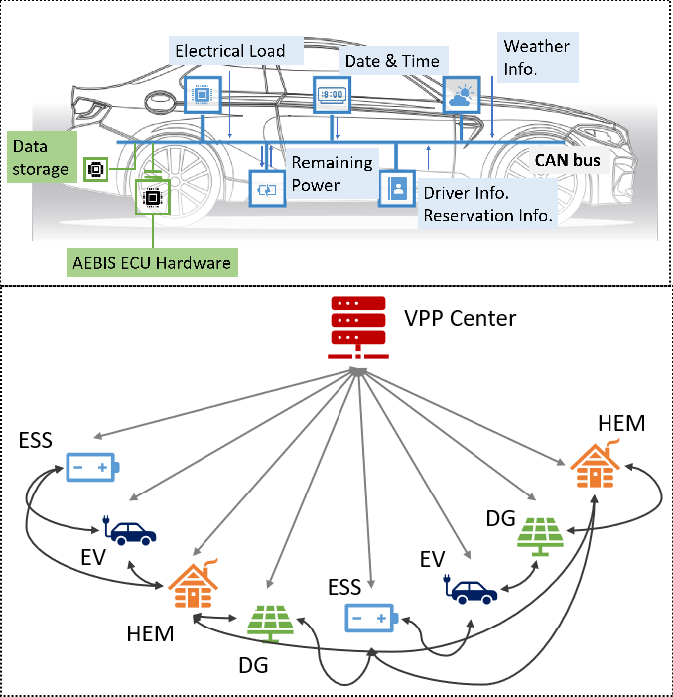
Our research is dedicated to the design and utilization of computers with minimal environmental impact, encompassing efforts to reduce energy consumption, minimize waste, and employ sustainable materials. By integrating cutting-edge technologies and innovative methodologies, we aim to develop solutions that not only enhance the efficiency and functionality of computing systems but also contribute to the preservation of our planet. Our multidisciplinary approach involves collaboration with companies and experts in various fields, ensuring that our findings and implementations are both practical and impactful.
...read more
Dissertation and Published Works
For a comprehensive list of major publications, please visit the following page:
https://web-ext.u-aizu.ac.jp/misc/neuro-eng/major-pub.html