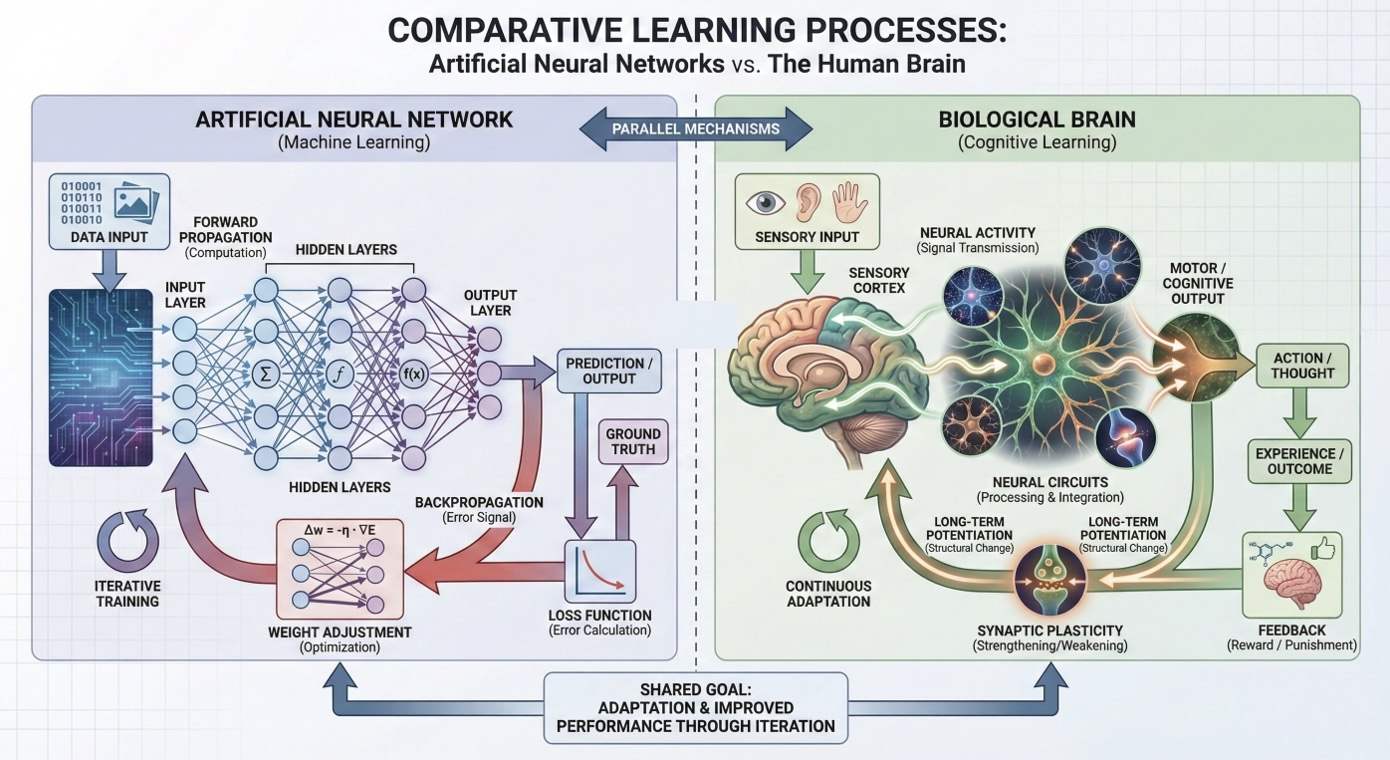
Advancing the frontiers of Artificial Intelligence and Learning Technologies through innovative research that bridges theoretical foundations and real-world applications. The research focuses on the design and development of intelligent tutoring systems, personalized and adaptive learning environments, mobile and cloud-based learning platforms, and data-driven educational technologies. Emphasis is placed on leveraging machine learning, recommender systems, and cognitive principles to enhance learning effectiveness, accessibility, and learner engagement across diverse educational contexts.
My research spans several areas of computer science, with an emphasis on building intelligent, data-driven systems that are effective, scalable, and user-centered. Key directions include machine learning and recommender systems, adaptive and personalized learning support, and the integration of mobile and cloud technologies for real-world deployment. Across these themes, the work combines rigorous modeling with practical evaluation to deliver measurable impact in educational and related application domains.
Research in artificial intelligence focuses on the design and analysis of intelligent computational models capable of learning from data and supporting complex decision-making processes. The work investigates both classical and modern AI techniques, with particular attention to robustness, optimization, and interpretability in real-world applications, including educational and data-intensive domains.
Research in recommender systems investigates data-driven methods for modeling user preferences and delivering personalized recommendations. The work emphasizes algorithmic design, evaluation, and optimization of recommendation strategies for information filtering, decision support, and personalization, with applications spanning education, multimedia, and health-related domains.
Research in learning technologies explores the development of intelligent educational systems that support personalized, adaptive, and evidence-based learning. Emphasis is placed on learner modeling, instructional adaptation, and data-driven feedback mechanisms that align system behavior with cognitive principles and diverse learning characteristics.
Mobile learning research addresses the design of flexible and scalable learning systems that leverage smart devices and ubiquitous connectivity. The work focuses on context-aware learning, multimodal interaction, and the integration of mobile platforms with cloud-based services to support continuous and location-independent learning experiences.
Author (and co-author) of over 100 peer-reviewed publications in leading international journals and top-tier conferences, contributing significantly to the advancement of artificial intelligence, recommender systems, and educational technologies. This body of work spans both theoretical foundations and applied research, with demonstrated impact on intelligent learning systems, data-driven decision support, and real-world AI applications.
Authors: L. Salau, M. Hamada, Y. Abdulsalam, M. Hassan
A hybrid model, which integrates deep learning and factorization-based techniques to improve multi-criteria recommendations.
Authors: Md Atiqur Rahman, Mohamed Hamada, Shayla Sharmin, Tanzina Afroz Rimi, Atia Sanjida Talukder, Nafees Imran, Khadijatul Kobra, Md Ridwan Ahmed, Md Rabbi, Md Mafiul Hasan Matin, M Ameer Ali
An enhanced machine-learning approach for breast cancer detection using the Wisconsin Breast Cancer (Diagnostic) (WDBC) dataset.
Authors: Bhasker Bapuram, Murali Subramanian, Anand Mahendran, Ibrahim Ghafir, Vijayan Ellappan, Mohammed Hamada
This paper presents an overview of the integration of IoMT and cloud computing technologies.
Authors: L. Salau, M. Hamada, R. Prasad, M. Hassan, A. Mahendran, Y. Watanobe
This comprehensive survey analyzes the current state of deep learning approaches in educational recommender systems, examining architectures, datasets, evaluation metrics, and future research directions.
Authors: J.J. Tanimu, M. Hamada, M. Hassan, H. Kakudi, J.O. Abiodun
Novel machine learning approach utilizing advanced neural network architectures for accurate cervical cancer classification, achieving significant improvements in diagnostic accuracy and clinical applicability.
Authors: M.A. Rahman, M. Hamada
Comprehensive review of lossless compression methods with performance analysis, comparative evaluation, and recommendations for various application domains including medical imaging and data archiving.
Authors: M. Hamada, M. Hassan
Development of an interactive virtual environment for teaching information and communication theory, incorporating adaptive learning mechanisms and real-time feedback systems.
Authors: M. Hamada
Pioneering work on virtual environments for collaborative learning in computational theory, featuring real-time interaction, automated assessment, and personalized learning paths.
Editor: M. Hamada
Comprehensive edited volume examining mobile learning trends, user attitudes, and effectiveness measures across diverse educational contexts and technological platforms.
Editor: M. Hamada
Comprehensive edited volume examining e-learning new technologies, practical applications, and effectiveness measures across diverse educational contexts and platforms.
View complete publication list with citation metrics and collaboration networks
Google Scholar ProfileMeasuring the influence, quality, and global reach of research contributions through scholarly publications, citations, and academic collaboration. The research impact reflects sustained engagement with the international research community and the practical relevance of scientific outcomes, contributing to the advancement of artificial intelligence, recommender systems, and learning technologies across diverse disciplines and application domains.